

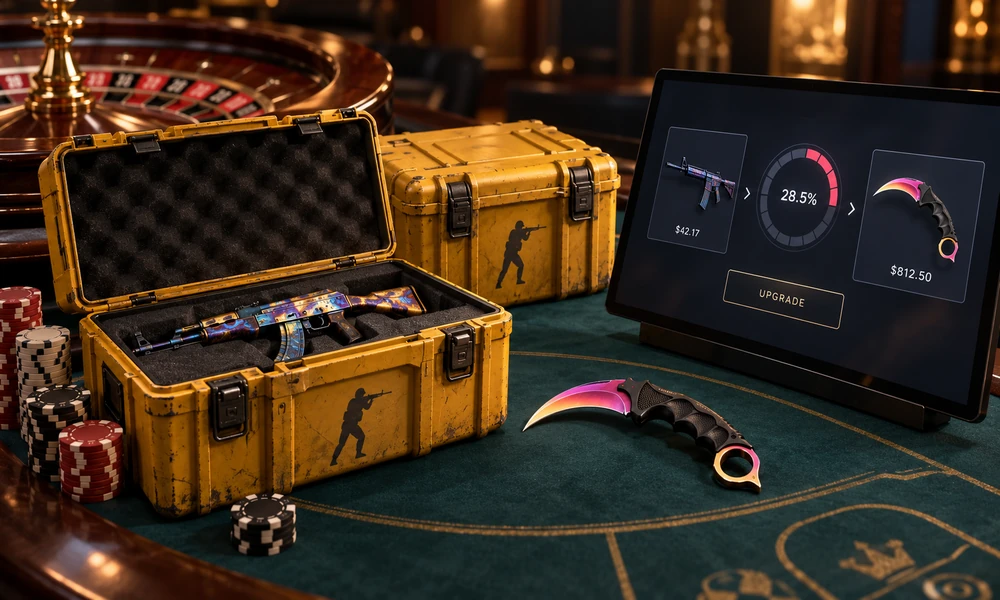
A case opening starts with a question: which skin will you get? An upgrader starts with a target: can you turn your current stake into something more valuable?
Both formats revolve around Counter-Strike skins, but they offer different experiences. One draws an item from a predefined pool. The other typically gives you a chance of obtaining a chosen item, with the possibility of losing the stake entirely.
Understanding that difference is the first step toward comparing platforms properly. The case artwork, spinning wheel and headline prize tell only part of the story.
How Third-Party Case Opening Works
On a typical case opening site, you pay a fixed price to open a virtual case containing a published selection of skins. Each possible result has an assigned probability.
These are the platform’s own cases. A familiar weapon or skin does not mean the case follows the contents, odds or pricing of an official Counter-Strike container.
The most expensive item attracts attention, but the full drop table determines the value of the case. A knife worth hundreds of dollars can appear alongside much cheaper skins, with very different probabilities attached to each.
Before opening, the useful questions are straightforward:
- What does one opening cost?
- What is the probability of receiving each item?
- How much of the drop table is worth less than the opening price?
- How are the displayed skin values calculated?
A case can award an item every time and still return less than it costs on average. Receiving a skin and making a profit are different outcomes.
How Skin Upgraders Work
In a typical chance-based upgrader, players select a stake and a target item. The stake may consist of skins, site balance or a combination, depending on the platform.
The game then displays a success probability. A successful attempt awards the target; an unsuccessful attempt usually consumes the stake without awarding it. Some platforms offer additional rewards or cashback, which need to be assessed separately.
The attraction is the ability to choose the desired outcome. However, choosing the skin does not mean controlling the result.
An upgrader is also different from paying the price difference in a normal trade. You are accepting a probability of success rather than purchasing a guaranteed exchange.
The Numbers Behind an Upgrade
Consider a hypothetical $10 attempt to obtain an item valued at $20, with a displayed success chance of 47.5% and no reward on failure.
The expected return is:
0.475 × $20 = $9.50
Relative to the $10 stake, that represents a 95% theoretical return and a 5% house edge, assuming the item valuations accurately reflect what you receive.
This does not mean every two attempts produce one win. It describes an average over a very large number of attempts under the same conditions.
Case openings can be assessed using the same principle: multiply each possible reward’s value by its probability, then add the results. That total is the expected value of the opening.
The calculation becomes less useful if the displayed prices are inflated or the items cannot be withdrawn at those values.
Skin Valuation Deserves Its Own Check
A skin’s price inside a platform is not automatically the amount you could receive by selling it elsewhere.
Wear, float, pattern and StatTrak status can affect the value of a particular item. Fees and market liquidity can also change what a seller ultimately receives.
For upgraders, check how the platform values both the input and the target. For case openings, compare the values assigned to the likely drops as well as the headline prizes.
This matters because generous-looking odds can be less attractive when paired with unfavorable valuations. The relevant comparison includes the probability, the stake and the realistic value of the reward.
What Provably Fair Verification Actually Adds
Some platforms provide a provably fair system that allows players to reproduce a result using disclosed game data, such as server seeds, client seeds and nonces.
The practical question is whether the platform provides a usable verification process. A badge alone does not explain how a result was calculated or how it corresponds to the published odds.
Verification also has limits. It does not establish that skin prices are competitive, that bonus conditions are reasonable or that withdrawals will be handled reliably.
Those are separate parts of the evaluation.
Compare the Platform Around the Game
The experience continues after the animation stops. Withdrawal stock, minimum amounts, identity checks, fees and bonus restrictions can all affect whether a displayed reward becomes a usable item.
For a broader comparison, FreeSkinsHub brings together CS2 gambling reviews and guides covering games, fairness, bonuses and withdrawals. That provides a useful starting point for comparing the overall platform alongside its case selection or upgrade interface.
Check the operator’s current terms as well. A review can help identify the questions to ask, while the platform’s rules determine the conditions attached to your account.
Choose the Format With Clear Expectations
Case openings suit the experience of revealing an unknown item from a set pool. Upgraders focus that uncertainty on a selected target. Neither format guarantees a cheaper route to the skin you want.
If the goal is ownership of a specific item, compare its direct purchase price with the cost and uncertainty of these alternatives. If the goal is entertainment, decide in advance what that experience is worth to you.
For adults who choose to participate where permitted, the strongest comparison starts with visible odds, credible valuations, verifiable results and workable withdrawals. Those details tell you far more than the value of the rarest skin on the page.